
Yap Yung Szen: The journey from quantum researcher to AQSolotl founder
Updated: Aug 6
The career of Dr. Yap Yung Szen spans more than two decades and three countries: from a physics and master degree in Universiti Teknologi Malaysia (UTM), to a Ph.D. obtained in 2013 at The University of Osaka on the control of electron spin qubits, a visiting researcher at the Centre for Quantum Technologies on superconducting qubits and ultimately to the co-founding of AQSolotl. Here is his story about the collaboration that would change everything.
Dr. Yap’s Career Milestones: A Visual Timeline


2018: a collaboration, and a problem worth solving
That year, with the support of UTM, Dr. Yap began working with Prof. Rainer Dumke. One of the first challenges they tackled together seemed, at first glance, rather unremarkable: the control system required to operate a quantum computer.
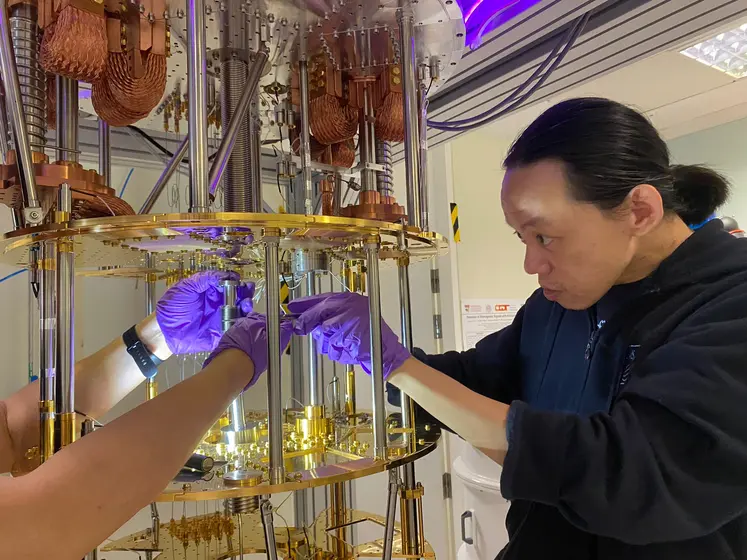
Dr. Yap at NTU in 2018
“We wanted to buy a control system at the time, and after looking at the price of existing systems, the cost simply didn’t make sense anymore once you wanted to scale to more qubits.”
Rather than accepting those limitations, they spent several years building their own alternative: ICARUS-Q, an integrated control and readout unit designed to be scalable. They used it to operate their own quantum computer and published their results — becoming one of the first teams in the world to control a quantum computer using an RFSoC, a radio-frequency system-on-chip.
“A particularly memorable moment for me was when we published the paper, because it was one of the first papers to use RFSoC for quantum computers.”
That paper, and the technology behind it, became the foundation of AQSolotl.
Where he is today?
Today, Dr. Yap is the sole expert in quantum computing hardware in Malaysia — a position that carries significant weight given the decades of research and hands-on experience behind it. He also holds a specially appointed Associate Professor position at the Center for Quantum Information and Quantum Biology (QIQB) at The University of Osaka, one of the few centres in the world entirely dedicated to advancing quantum science.

Dr. Yap presenting his lab to the Malaysian Minister of Higher Education (2026).
This year, his work received international recognition: he was selected for the Quantum 100, a global initiative launched as part of UNESCO’s International Year of Quantum Science and Technology (IYQ), celebrating the 100th anniversary of quantum mechanics and highlighting 100 individuals shaping the future of the field.
Despite such an impressive journey, Yap is quick to emphasise that his achievements are also the result of the people who supported and helped him along the way.
“I have been very lucky meeting and working with people both in Malaysia and abroad. My department heads and the faculty deans at UTM, also since 2018, have been very supportive and that is something I truly appreciate.”

Comments