
Quantum computing, in five minutes flat.

Updated: Aug 26
Our way of simplifying the complex quantum world we live in.
What's ahead
What a quantum computer actually is, what a qubit is (and the different flavors labs build them in), what a quantum controller does, and why Aqsolotl is betting everything on that one layer.
What is a quantum computer?
A different way of computing, not just a faster one.
1. Bits vs. qubitsA regular computer stores information as bits: each one is a strict 0 or a 1. A quantum computer stores information as qubits: units that follow the rules of quantum physics instead.  | 2. SuperpositionA qubit can hold a mix of 0 and 1 at the same time. However the real power isn't just the number of states, it's what superposition lets you do with them. It allows a quantum computer to compute and navigate across all those states at once. |
3. EntanglementMeasuring or interacting with one qubit instantly affects another even on the other side of the chip. This is where the real magic and complexity of quantum computing resides: the power of superposition can only be harnessed because qubits are entangled, linked together as one coordinated system. It's why two separate 5-qubit quantum computers don't perform the same computation as a single 10-qubit one. | |
Why it matters?Superposition and entanglement let a quantum computer explore many possible answers in parallel. For the right problem, that can mean solving in minutes what would take a classical computer millennia. | |
Real-world applications & a fast-growing marketDrug discovery, materials and battery design, logistics optimization, financial modeling, and cryptography are the problems quantum computers are expected to unlock first.  The market reflects that momentum: McKinsey's Quantum Technology 2026 report values it at $43–71bn by 2035, growing to $198bn by 2040.  | |
It's not a faster laptop: quantum computers are a fundamentally different tool, useful for specific hard problems not for browsing the web or opening a spreadsheet. | |
See more about Mckinsey study on quantum market: https://www.mckinsey.com/capabilities/mckinsey-technology/our-insights/mckinsey-quantum-technology-monitor-2026-a-commercial-tipping-point
Where are we in this world?
What is Aqsolotl?Aqsolotl is a Singapore-based deep-tech startup, spun off from Nanyang Technological University (NTU) and the National University of Singapore (NUS). We commercialize quantum control technology born at the Centre for Quantum Technologies. Our flagship product, Chronos-Q, is a quantum controller |
Our missionOur mission is to democratize quantum computing. A quantum computer can't run without a controller. It's the piece that actually drives and reads the qubits, so no controller means no computation, no matter how good the chip is. Chronos-Q is built to keep up with that demand: it scales smoothly as chips pack in more qubits, and stays cost-efficient at scale. Therefore, it's still affordable and usable when the quantum revolution reaches machines with thousands of qubits, not just today's small prototypes. |
And our product?
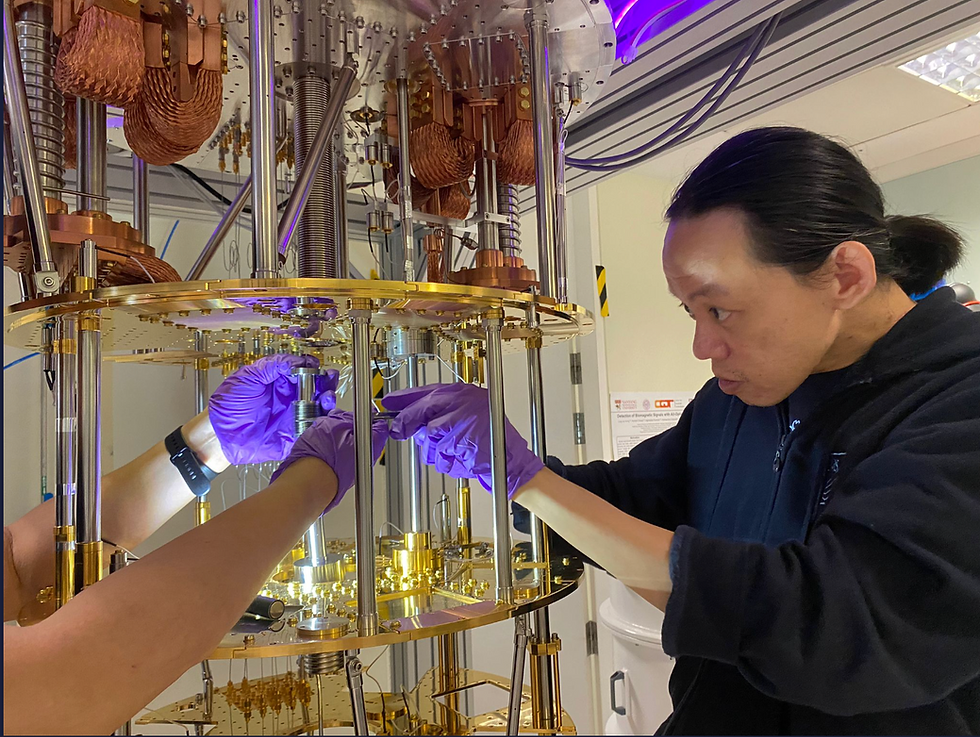
Qubits are fragile: they need to be precisely pulsed with microwave or laser signals to be set, changed, and read out all within nanoseconds. A quantum controller is the electronics stack that generates those signals and reads the results, acting as the interface between a normal computer and the quantum chip. Without a controller, a quantum processor is just an inert chip in a fridge. The controller is what actually makes it compute. |
Where Chronos-Q fits

 | Our product: Chronos-QChronos-Q is our quantum controller: compact, modular, and dramatically cheaper than legacy systems, while reading out qubit states in under 20 nanoseconds for real-time feedback. |
|
Why the controller is our strategic bet
Quantum chips get the headlines, but the controller is where the real bottleneck — and the real business opportunity — lives.
Every qubit needs oneWhatever qubit technology wins — superconducting, trapped-ion, photonic — every quantum computer needs a controller to drive and read it. We're not betting on one chip type; we sell the layer underneath all of them. | The real bottleneck to scaleAdding qubits is easy on paper; controlling thousands of them precisely, in real time, is what actually blocks progress today. Whoever solves control economics unlocks the next generation of machines. |
Recurring, not one-offControllers are upgraded, replaced, and scaled with every new generation of hardware — a durable, repeat business, unlike a single chip sale. | Lower cost, wider accessLegacy control systems are bulky and expensive. Chronos-Q's compact, modular design cuts cost and footprint — opening quantum hardware to labs and companies who couldn't afford it before. |
In quantum computing, the chip gets the attention while the controller decides who actually gets to compute. That's the layer Aqsolotl owns. | |


Comments